Checklist: Is Assisted Living the Right Choice for My Loved One?

Approximately one million older Americans are living in assisted living facilities and communities today. Residents choose assisted living because it offers the combination of a private, home-like residence—often a studio or one-bedroom apartment—as well as support to meet personal care and some health care needs. According to the National Center for Assisted Living, the typical assisted living resident is an 86-year-old woman who is mobile but needs help with a few of the activities of daily living, such as bathing, dressing, grooming, using the bathroom and transferring from bed to chair. This assistance is provided in addition to the basic services that typically go with retirement housing, such as housekeeping, laundry, transportation and meal service.

Assisted living is an important middle option for seniors who are concerned about their present or future ability to live independently, but who are also not in need of the skilled nursing care provided at a nursing home.

Families should be alert for signs that an older relative is no longer safe and healthy living at home. Is your loved one ready for assisted living? Here are some questions to ask:

  • My loved one’s home is as clean, tidy and in good repair as ever.   YES   NO
  • My loved one eats well and is able to prepare nutritious meals.   YES   NO
  • My loved one’s home is convenient and safe for a person with his/her mobility level.   YES   NO
  • My loved one has plenty of opportunities for physical activity and socializing with others.   YES   NO
  • My loved one is able to manage medications and take them correctly.   YES   NO
  • My loved one is able to manage doctor’s appointments and other healthcare tasks.   YES   NO
  • My loved one drives, or has access to good alternate transportation.   YES   NO
  • Our family is confident that our loved one is well-off living at home.   YES   NO
  • My loved one could get help right away in the event of a fall or other emergency.   YES   NO

If you answered “no” to several of these questions, learn more about the ways the supportive environment of an assisted living community promotes independence, health and safety for senior residents. As you select a facility, investigate the services offered to be sure they are a good fit for your loved one’s needs. Remember that services vary widely. Some facilities provide only limited help with personal care, health care needs and medication management. Others include a broad range of health care services. More facilities today offer specialized care for residents who have Alzheimer’s disease or other dementia. Make sure you understand the maximum level of care available in each facility, and what procedures would be followed if the time were to come when your loved one’s needs were greater than could be met at the facility.

Copyright © AgeWise, 2013

Posted in Assisted Living Residents, Caregiving, Families, Home Safety | Tagged | Leave a comment

Dictionary of Eldercare Terminology: 95-Year-Old Attorney Releases Updated Edition of His Classic Compendium

Anyone in the field of aging knows that it has its own unique language.

Understanding all the shifting terms, however, can be a challenge.

Walter Feldesman, a prominent New York attorney for more than 65 years, recognized this need in 1997, when he published the first edition of his Dictionary of Eldercare Terminology .

It remains the first and only dictionary defining eldercare words and terms.

At 95, Feldesman recently released the third edition of the dictionary and is making it available online through the website of the National Council on Aging (NCOA).

“Walter is an incredible example of someone who continues to contribute to society well past the traditional retirement age,” says NCOA President Jim Firman. “That’s why we gave him the first NCOA Exemplar of Vital Aging Award in 2009. Now, we’re proud to offer his newly updated dictionary as a great online resource for anyone interested in aging.”

Feldesman entered the world of elder law informally in 1990 when his bedridden mother-in-law asked him who was paying for all of her care. He did not have an answer—so he started researching.

The result was a comprehensive dictionary that includes overviews of major eldercare fields, including home care, long-term care insurance, Medicaid, Medicare, Medicare supplemental insurance, and Social Security. The new, third edition includes a wide mix of gerontological terms, as well as financial, estate planning, and legal terms related to eldercare.

The first two editions were quoted, cited, and accredited by many sources, including Medicare’s consumer handbook Medicare and You and the official Medicare website, www.medicare.gov.

Feldesman has served on numerous boards, including NCOA’s Leadership Council. He enjoyed a long and distinguished career as a corporate attorney, director of public companies, hospital and college trustee, philanthropist, and author.

Source: The National Council on Aging (www.ncoa.org), a nonprofit service and advocacy organization headquartered in Washington, DC. NCOA works with thousands of organizations across the country to help seniors find jobs and benefits, improve their health, live independently, and remain active in their communities.

Posted in Ageism, Healthcare System, News | Tagged , | Leave a comment

Help Older Loved Ones Beat the Heat

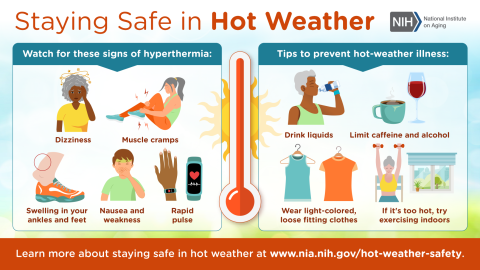
As we grow older, our bodies are less efficient at regulating temperature. Especially at risk are people with health problems such as cardiovascular disease, kidney or lung problems, unhealthy body weight, or those who take certain medications that interrupt the body’s ability to protect itself by perspiring.

Here are some tips for staying safe and comfortable during periods of higher heat:

  • Drink plenty of fluids, even if you don’t feel thirsty. On hot days, the body loses moisture more rapidly, so keep hydrated with water or fruit juice. Avoid caffeine and alcohol, which cause the body to lose more fluid.
  • Keep your home cool by letting in cool air during the early morning and evening hours. If you do not have air conditioning, create cross-ventilation by opening windows on two sides of the building. Use fans to circulate cooler air. Close curtains and blinds during the warmest hours.
  • Take a break at an air conditioned location during the hottest part of the day. Go to the mall, a movie, the library.
  • Dress for the weather. Wear short-sleeve, loose-fitting garments. Natural fibers and light colors are cooler than synthetic materials and dark colors. And don’t forget your sun hat!
  • Exercise and work outside only during the cooler hours of the day, and pace your activities.
  • Wear sunblock when you are outdoors. Sunburn reduces the body’s ability to regulate heat.
  • Be aware of the symptoms of heat exhaustion:  dizziness, weakness, nausea and perspiration.

If a loved one shows signs of heat-related illness, seek medical attention right away.

Copyright © AgeWise, 2013

Posted in Health, Healthy Aging | Tagged , | Leave a comment

Five Myths About Exercise and Healthy Aging

By now most of us know that physical activity is a top contributor to longevity and health in our later years. With the aging of the baby boomers, more attention is being paid to understanding the ways that exercise helps reduce the toll of chronic illness on the health of seniors and on the financial health of our long-term care system.

Over the past year, research has shed new light on some common misperceptions we might have about exercise. Here are five myths—and facts that can help us design our own optimal exercise plan.

Myth #1: Exercise only benefits the body.

Exercise benefits our hearts, muscles and bones, and reduces the risk of an array of health problems, from diabetes to kidney disease to arthritis. But many people are unaware that another very important organ—the brain—is also damaged by inactivity. You’ve probably read about “brain fitness games” and special computer programs to build up the mind and memory. But exercising the muscles is equally important when it comes to protecting brain health. Physical exercise strengthens connections in the brain and lessens the damaging effects of stress and depression. Within the past year, a study from the American Heart Association used brain imagery to demonstrate that exercise lessens the brain damage caused by stroke and diabetes. Another study from the Radiological Society of North America also used imaging, showing that exercise slows shrinkage of the brain as we age. Said Dr. Cyrus Raji, “Our initial results show brain aging can be alleviated through an active lifestyle.” Dr. Raji also noted that engaging in a variety of different activities is the most beneficial. Activities that simultaneously engage both mind and body may be especially beneficial. Maybe taking up square dancing is a good choice?

Myth #2: Your age determines your optimum fitness routine.

Gerontologists say that with very few exceptions, older adults benefit from adding more physical activity to their lives. But the appropriate type and intensity of exercise varies from individual to individual—more so than was the case when we were younger. Some of us are fortunate enough to have a combination of genes, lifestyle history and luck that allow us to continue an exercise program that matches or even exceeds the activities of our younger years. For others, a modified, low-intensity physical activity prescription is recommended. As we grow older, it is more important than ever to discuss our exercise plan with our healthcare provider to be sure all activities are both safe and beneficial. The American Academy of Orthopaedic Surgeons recommends that no matter what the intensity level of a person’s workout, it should include aerobic, strengthening and flexibility components, as well as exercises that improve balance. Bicycling, dancing, walking the dog, working out on adaptive equipment at the gym, chair exercises, even playing active video games (such as the Wii system) can all provide a good workout, depending on our needs.

Myth #3: Running is better exercise than walking.

For weight loss, running has been found to be more effective than walking. But losing weight is not the only reason we need to be physically active. Last month in its journal Arteriosclerosis, Thrombosis and Vascular Biology, the American Heart Association reported that moderately paced walking is just as effective in reducing blood pressure, cholesterol levels and the risk for diabetes and heart disease. Researchers from the Lawrence Berkeley National Laboratory in California examined the data from the National Runners’ Health Study, which collected information on 33,000 runners and 16,000 walkers over the course of six years. The study compared the benefits by the distance people covered, not by the amount of time the workout took, and found that whether people walk or run, they gain similar health benefits over the same distance. Said principal author Dr. Paul T. Williams, “The more the runners ran and the more the walkers walked, the better off they were in health benefits. If the amount of energy expended was the same between the two groups, then the health benefits were comparable.”

Myth #4: Exercise must be scheduled and structured.

Sporadic, occasional activities like a hike every couple of weeks don’t provide the same benefit as regular, frequent exercise. However, recent research suggests that your daily exercise goals needn’t be achieved during a single time period, nor do you need a strict routine. Oregon State University researchers recently reported that small amounts of activity—even as small as one- and two-minute increments that add up to 30 minutes per day—can be just as beneficial as longer bouts of activity in the gym. OSU professor Brad Cardinal says, “We are designed by nature as beings who are supposed to move. In our society, you will always be presented with things that entice you to sit or be less active because of technology, like using a leaf blower instead of a rake. Making physical activity a way of life is more cost-effective than an expensive gym membership. You may be more likely to stick with it, and over the long term, you’ll be healthier, more mobile and just feel better all around.” Added study lead author Paul Loprinzi, “Our results suggest that engaging in an active lifestyle approach, compared to a structured exercise approach, may be just as beneficial. Seek out opportunities to be active when the choice is available. For example, rather than sitting while talking on the phone, use this opportunity to get in some activity by pacing around.” Loprinzi advises people to look for small ways to be more active: instead of driving half a mile, try biking or walking the same distance; instead of using a riding lawn mower, use a push mower; instead of sitting through TV commercials, use the time to do some sit-ups or jumping jacks.

Myth #5: The baby boomers are the most physically fit generation ever.

The baby boomers, that large group of Americans born between 1946 and 1964, have a reputation as being very fitness-conscious. The stereotype boomer goes running every day, works out at the gym, and has a personal trainer. Yet contrary to this image, recent research suggests that the boomers are actually in worse health than their parents. In the March 2013 issue of the Journal of the American Medical Association, West Virginia University researchers reported that the boomers have a higher rate of poor health and disabilities than did their parents’ generation. The Centers for Disease Control and Prevention even predict a decline in life expectancy as obesity leads to an increased rate of hypertension, diabetes, high cholesterol and chronic disease. What is responsible for this startling trend? Only 18 percent of boomers get the recommended daily amount of exercise. And we now know that even people who exercise regularly experience a decline in health when they spend most of the rest of the day sitting. Our bodies did not evolve to spend hour upon hour in a chair or on a couch—yet today’s culture, more than ever, finds many of us at a desk for eight hours or more, emailing our office mates rather than walking down the hall, sitting down all day…right into our leisure hours, which are often spent engaged with a variety of tempting—but sedentary—electronic entertainments. Despite their image of active senior living, the boomers shouldn’t rest on their laurels—or their recliners. Follow a regular exercise program and be sure to engage in regular small amounts of activity throughout the day.

Copyright © AgeWise, 2013

Posted in Ageism, Diet and Healthy Eating, Exercise, Health, Healthy Aging | Tagged , | Leave a comment

“Exercise and Healthy Aging” Word Scramble

No matter what your age, exercise offers a healthy aging boost.

Give your brain a workout as well with this month’s puzzle, which is all about the many ways physical activity benefits our minds and bodies.

Click here  to download and print the puzzle.

Copyright © IlluminAge AgeWise, 2013

Posted in Exercise, Fun, Health, Healthy Aging, Memory Care | Tagged | Leave a comment

Lutheran Homes of South Carolina Execs Installed as Board Members for LeadingAge SC

During the LeadingAge SC Annual Business Meeting in April, Lutheran Homes of South Carolina Executives were installed as new board members for the association.   LeadingAge nominating chair, Ms. Sarah Tipton, installed Denise Dickinsen, Vice President of Planned Growth & Development and Connie Henrich, Executive Director at Trinity on Laurens and BeWell Home Services new board members.

Posted in News | Tagged , | Leave a comment

Interview Featured in June Edition of Columbia Business Monthly

Take a look at the June edition of Columbia Business Monthly: “Recession & Retirement” featuring an interview with Denise Hudson, Rice Estate Community Outreach Director!

Posted in Financial, News | Tagged , | Leave a comment

Growing Good Garden Habits

Fresh air and fresh veggies! Delicious garden treats to nourish our bodies, and perhaps a bouquet of flowers to nourish the spirit! Experts in healthy aging have long known that gardening and yard work provide good exercise and a great mood boost as well. Seniors who garden also consume on average more vegetables and fruit in their diets.

Experts from Chicago’s Loyola University Health System remind us that just as with any form of exercise, it’s important to practice safe body mechanics while planting, pruning, weeding and raking.

“Working in your garden is a great way to exercise. Whether pulling weeds or spreading mulch, you are using major muscles all over your body and you’re sure to break a sweat,” said Kara Smith, special programs coordinator for the Loyola University Health System’s Center for Fitness.

The Center offers these gardening exercise tips:

  1. Don’t make it a marathon; keep a regular gardening routine. Schedule at least 30-60 minutes of yard work two to three times per week.
  2. Warm up your body by taking a brisk walk around the yard.
  3. When raking, change the movement and alternate the sides of your body to ensure you are working them equally.
  4. When digging, switch hands often so you are using both arms. This helps prevent muscle imbalances, repetitive motion injuries and blisters.

As with any good exercise program, be sure to cool down with stretches to help alleviate post-yardwork aches and pains:

  1. Hamstring stretch: Stand with feet shoulder width apart and slide one foot in front of the other. Gently sit your hips back and support your upper body on the leg you did not move. Hold for 15-30 seconds and switch legs.
  2. Lower back stretch: Stand with feet shoulder width apart. Bend knees slightly and bend at the hips. Support your upper body with your hands on your thighs. Gently round your back so it arches like a cat.
  3. Chest opening: Stand tall and relax your shoulders down your back. Reach hands back with thumbs pointing up. If this is uncomfortable, grasp hands behind back and lift your chest.
  4. Upper-back stretch: Stand with your feet shoulder width apart. Bring palms together and reach arms away from body. Feel the stretch between your shoulder blades.

To ensure a healthful experience, here are a few more tips to keep in mind while working in the yard:

  1. Wear sunscreen, long-sleeved shirts, pants and a wide-brimmed hat to limit sun exposure to your skin.
  2. Drink plenty of water.
  3. Bend at your knees and keep your back straight when lifting heavy items.
  4. Use a kneeling cushion to support your knees.
  5. Use gloves to help prevent blisters on your hands.
  6. As with any exercise program, be sure to check with your physician before you start and listen to your body for signs of stress and fatigue.

Based in the western suburbs of Chicago, Loyola University Health System is a quaternary care system including the main medical center campus, Gottlieb Memorial Hospital and 28 primary and specialty care facilities in Cook, Will and DuPage counties.

For More Information

The Centers for Disease Control and Prevention (CDC) offer more health and safety suggestions for gardeners, including tips for people with disabilities.

Posted in Diet and Healthy Eating, Exercise, Fun, Health, Healthy Aging, Home Safety | Tagged , , | Leave a comment

Senior Men At Highest Risk for Skin Cancer

June is National Men’s Health Month! During this month, men are reminded about the importance of staying healthy. With summer here, older men should put skin cancer education and prevention at the top of their healthy living to-do list!

The American Academy of Dermatology (ACD) warns that men older than 50 are at highest risk of developing melanoma, the deadliest form of skin cancer. Yet a recent ACD survey found that men are not only less informed about skin cancer, but are also much less likely to take precautions to avoid it.

The survey found that under one-third of men take proper precautions to protect their skin while in the sun, as compared to 43 percent of women who do so. Many of the men surveyed say they “prefer to enjoy sunshine and not worry about what they should do to protect themselves from it.” And only half of the men knew the signs of skin cancer or how to examine their skin for signs of the disease.

“This survey demonstrates that many men do not protect themselves from the sun when outdoors and that some still believe that sun exposure is good for their health. This is a very troubling combination in light of the fact that the major risk factor for melanoma is exposure to ultraviolet light,” said Dr. Thomas E. Rohrer, associate professor of dermatology at Brown University School of Medicine. “Men need to examine their skin and see a dermatologist if they spot anything changing, bleeding, or growing.”

Early detection is vital. The AAD says that when melanoma is detected before it has spread, the five-year survival rate is 98 percent. Those odds should motivate senior men and those who love them to be aware of prevention and detection. Says Dr. Rohrer, “Loved ones can assist by examining their partners’ skin and noticing anything suspicious. These exams are vital since the early detection of skin cancer helps save lives.”

View the American Academy of Dermatology’s “Spot Skin Cancer” website (www.aad.org/spot-skin-cancer) to learn more. Sit down with the older men in your life to watch the short, humorous “Golf” video to start the conversation.

Source: AgeWise reporting on information from the American Academy of Dermatology

Posted in Caregiving, Health, Healthy Aging, News | Tagged , | Leave a comment

BeWell Home Services Interviews Featured in Local Magazines

BeWell Home Services featured this month in interviews with Cathi Cooper and Heather Brazell:

Interview with Cathi Cooper on page 33 of Lexington Woman Magazine


Interview with Heather Brazell on page 26 of Aiken Woman Magazine

Posted in BeWell Home Services, News | Tagged | Leave a comment